It all began with a bear. Animal lovers Howard Rambo and Wallace Goodman had been selling and servicing Dodge and Plymouth vehicles since 1925, but in 1933 they also invited customers to see and feed their “Mexican bear cub,” and commented that it would “eat anything.”
In 1934, a local farmer captured an armadillo and it too, found a home at the dealership. According to the newspaper, they also had a possum and a coyote, and were expecting a deer from Kansas.
In January 1935, they added a “cinnamon bear, hyena, and fox.” In February, Wallace’s brother, Charles, from Oklahoma City, bought out Howard’s interest in the business. George Pease, from south Texas, delivered three monkeys to Goodman & Goodman later that spring. The “bears and monkeys” were part of the Lion’s Club Pet Parade.
A pair of ring tail monkeys were acquired in September 1936 and fought with some of the larger monkeys already in the menagerie. The agility of the new monkeys finally worked to their advantage. That fall, one of the monkeys escaped, apparently on a mission. A nursery school teacher had taken her class on regular trips to see the monkeys. When they stopped visiting for a while, one of the monkeys broke out and the newspaper reported that he was headed to the nursery.
In the summer of 1937, the Goodmans went outside their own collection and engaged the services of “Queenie, the performing elephant” to attract customers to their used car lot. Thankfully, they didn’t keep her.
InNovember1941,Goodman &Goodman began building a new garage at Fifth and Evergreen. The new home planned for the monkeys would have concrete floors, electric lights, gas heat, and running water. That same month Miss Haye’s and Mrs. McMain’s students enjoyed a trip to see the monkeys at their old location.
March 1942 was the formal opening of the new and modern Goodman & Goodman dealership and garage. Clyde Madders managed the monkeys. He commented, “You can’t tell a darned thing about a monkey’s disposition until he’s a year or two old;” that’s why they didn’t immediately name them. Some of the monkey names used over the years were Tiny, Hitler (the meanest), Mammy, Feisty (Tiny’s baby), Bozo, Squealy (loudest), Minnie, and Junior. They lived in comfort in their six private apartments, with the “latest gadgets.” They also had a swimming pool. Their favorite foods were English peas, bananas, and salted peanuts.
In October 1943, Bozo, an older monkey, “nearly tore the arm off Minnie.” John Odell and Baldy Barrentine were his handlers and punished him for his action. John “wielded a broom and Baldy “swung a paddle.” John predicted, “He’ll have to stand up to eat his meals for several days.”
Squealy was released from her cage in June 1944 because she was disturbing a new mother and her baby. Normally she returned when called after a brief outing; this time she refused to return. She stayed in the area overnight and was seen by residents. The paper didn’t mention her capture.
In February 1946, wolf hunters J. A. Roberts and Tom Risner captured a fox in their trap and took it to Goodman’s. It took a while for the fox and monkeys to settle down and tolerate each other.
Junior loved to swim in their little pool. He not only cooled off on hot days, but hid underwater when he got into trouble. He was notorious for teasing the latest baby monkey. Ironic since he was often the father. Tiny had his baby in April 1948.
Most readers of the Durant Weekly News were probably not surprised to see the obituary of a monkey printed in the paper in January 1951. His antics and occasional escapes had garnered him quite a bit of attention over the years. Bozo was one of the original three and 18 years old.
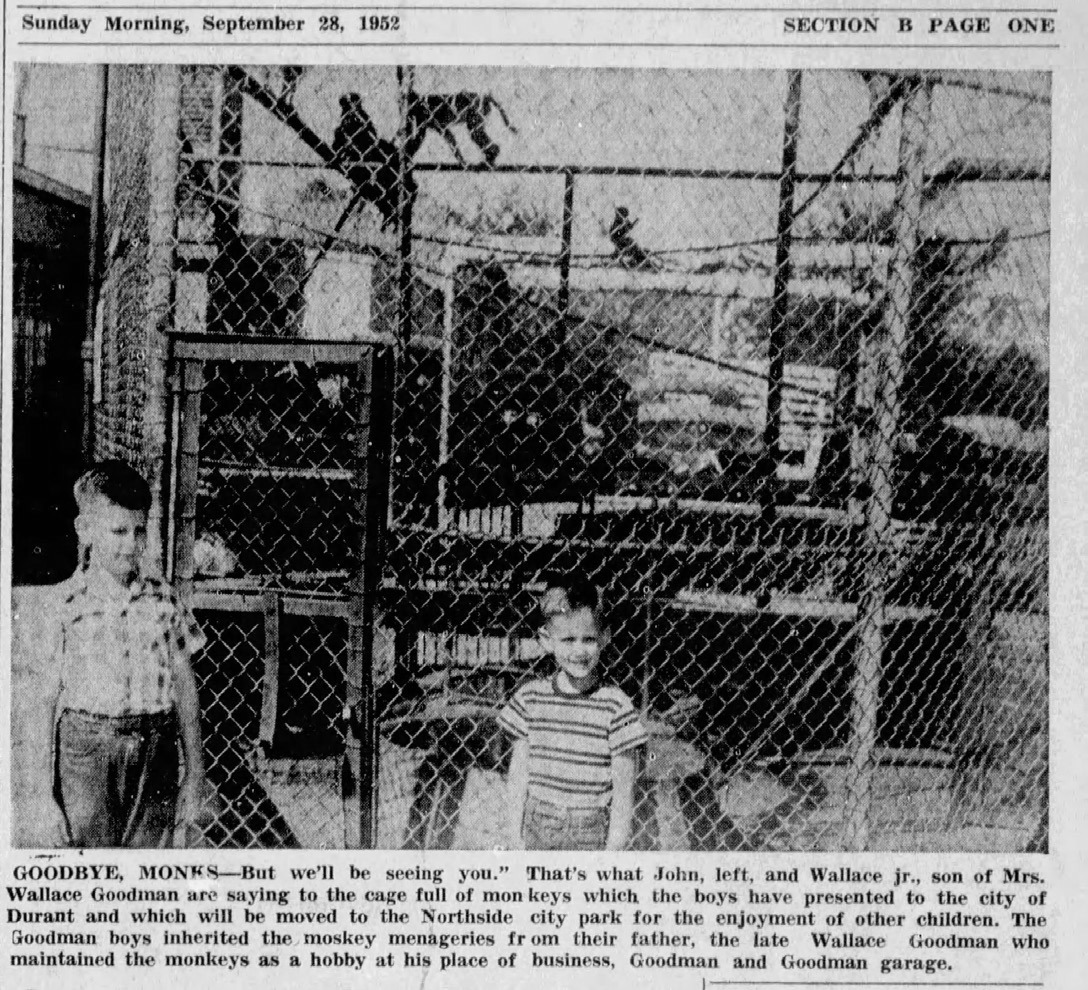
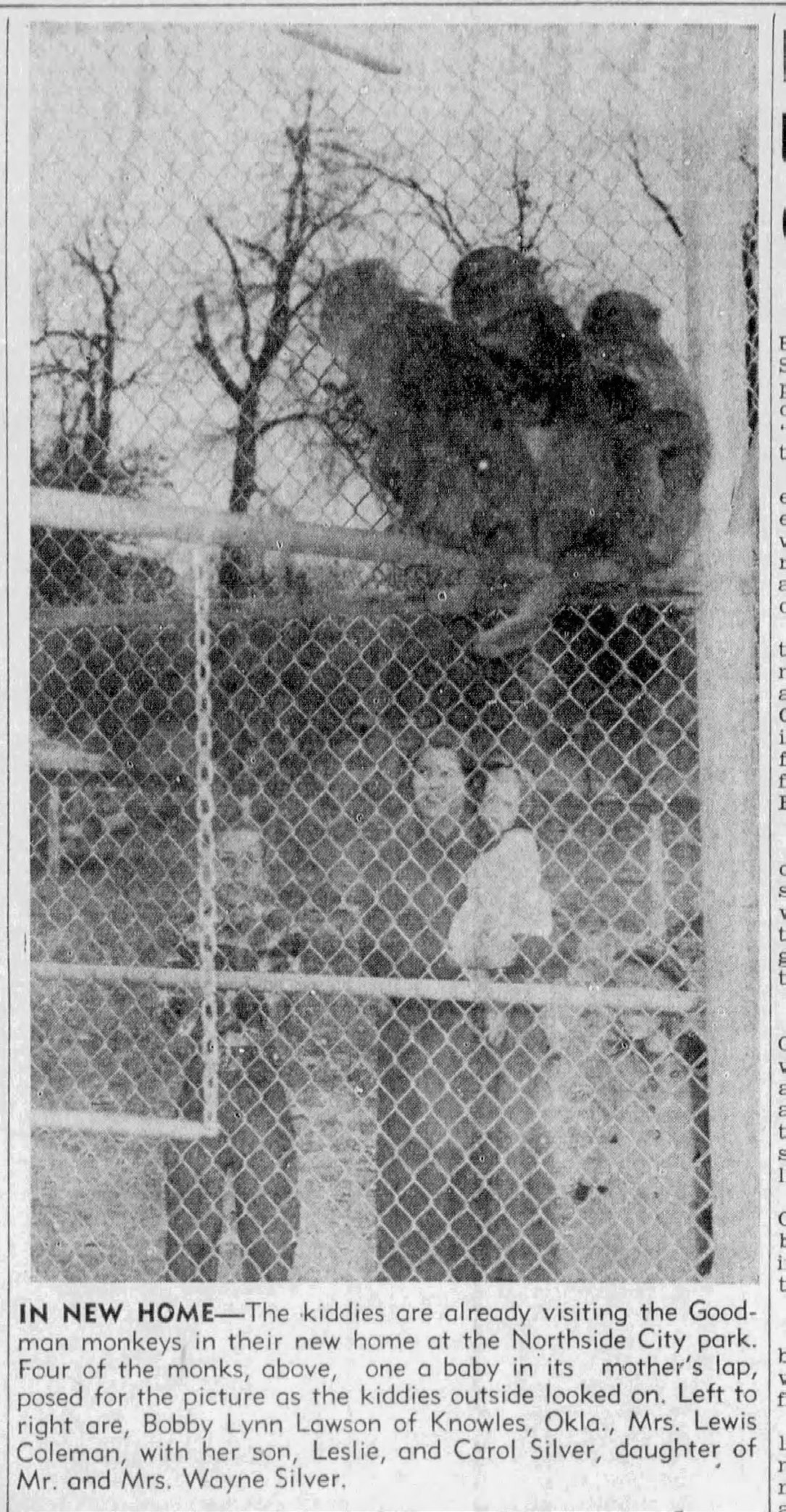
In September 1952, John and Wallace Goodman Jr. gave the 11 monkeys remaining in the menagerie to the city of Durant. Hollis Hampton was the chairman of the park board and determined that Northside Park (later renamed Dixon Durant Park) would be the best place for them. Their quarters at Goodman could not be moved, so a new compound was built for them. It included a small brick house for shelter, and a water supply. OK Iron and Metal Works donated the steel for the cages. Steakley Chevrolet donated the heavy wire. George Holly, park custodian, added their care to his duties.
Halloween pranksters in 1955 broke the cage lock and released three monkeys. The freed animals wandered all over town and the police department received more than 100 calls about them. Later one of the officers said, “Those monkeys sure made monkeys out of us.”
At a council meeting in 1958, the park board discussed a purchase offer for the monkeys. Details were not mentioned. The offer must have been refused, because a 1962 public survey cited as suggestions for improving the park: “catch the monkeys” and “keep the monkeys in their cages.”
In 1963, a visitor from West Virginia stopped by the newspaper office to voice his concern about the “monkeys in their cold cage.” He was advised to see the city manager.
In January 1964, a local women’s group assessed Northside Park’s condition. They turned in a list of eight suggestions, but made no mention of the monkeys or their cages. It’s unclear whether they were still in the park.
In 1988 Mary Park, director of the Three Valley Museum, created a coloring book about Durant’s history and included a page about the monkeys. A few years ago that book was reprinted and again made available to area students. Many older residents have fond and not-so-fond memories of Durant’s privileged primates.