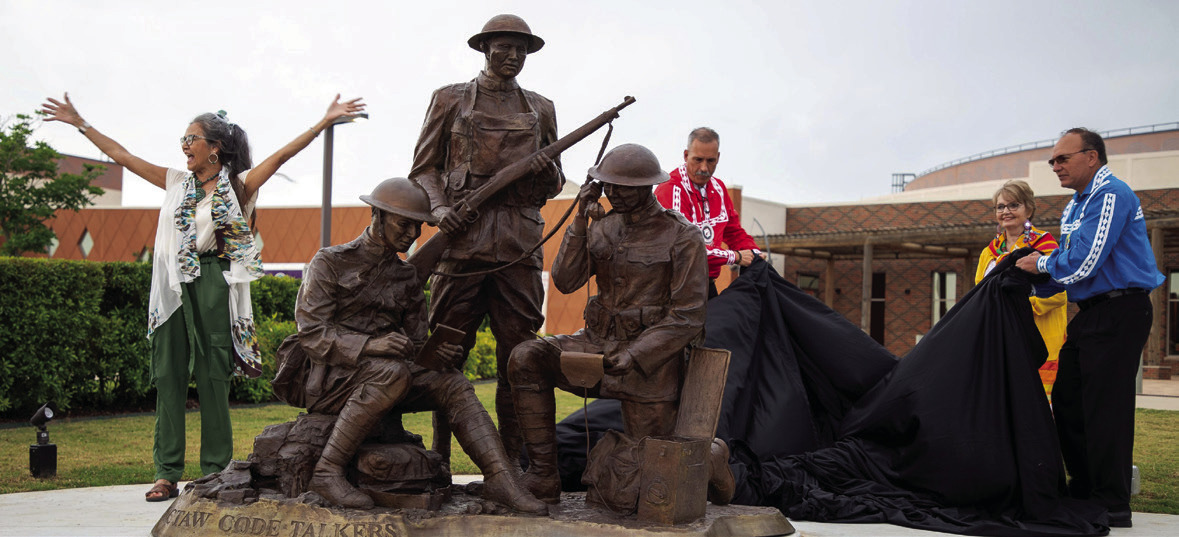
A new sculpture honoring the heroic World War I Choctaw Code Talkers was unveiled May 22 at the Choctaw Cultural Center.
The tribe said The 6-foot-8-inch tall and 8-foot-wide bronze sculpture is artist Jane Semple Umsted’s sixth sculpture she has made for her tribe, in addition to many paintings displayed throughout Choctaw facilities.
The Choctaw Code Talkers were the first American Indian tribe to develop a code for their language to transmit military messages on the battlefield. While these young Choctaw men put their lives on the line in World War I to be warriors for the United States, about one-fourth of American Indians were not yet citizens. Many tribes did not receive citizenship until 1924.
Choctaw Nation Chief Gary Batton said he loves that the tribe is keeping its culture and language alive. He said that he also wants to keep the Choctaw Code Talkers story alive so that their legacy will live on.
“This monument honors our brave Choctaw warriors whose extraordinary service helped bring an end to a devastating war,” Batton said. “The 19 young Choctaw soldiers commemorated by this sculpture who were the first to use their native language as a military code during World War I. Their innovation confused the enemy and played a key role in shifting the momentum of the war.”
Batton said that when officers overheard them speaking their native language on the battlefield, a groundbreaking idea was born. The Choctaw soldiers were trained to use their language as as secure code. Strategically placed on front lines and at command posts, they transmitted critical military messages that the enemy could not decipher.
“At the time, the German forces were intercepting allied communications, gaining insight into troop positions and supply locations,” Batton said. “Once the Choctaw men began transmitting messages in their native tongue, the Germans were unable to decode the information, effectively neutralizing their advantage.”
Nuchi Nashoba, president of Choctaw Code Talkers Association, thanked the tribe for having the historical event of the unveiling of the sculpture.
“We’ve waited a long time for this day to happen and I’m so delighted because when you see something this historic happen, you can’t help but be emotional,” Nashoba said. “When I first saw the statue, I cried because you know what? It makes you know that it was our loved ones that went to World War I. They left their families behind. They left everything they knew behind, and this was for us today and this is such a historical event that as chief said, ‘When we’re gone, this legacy will live on.’” Umsted said the unveiling was one of the proudest moments of her life.
“I look around and I see my friends and my family,” Umsted said. “I see my fellow members of the Choctaw tribe of Oklahoma and see all of the support that I’ve received. I feel like it came upon me by the help of God to be able to have the ability to replicate and depict such an awesome and significant time in history that’s going to be universally appreciated.”
“Right now, I’m standing here and realizing that really, God helped me. God helped me be at the right place at the right time when the Code Talkers Association came to me and commissioned me to do this project.”
Umsted spoke of how the Choctaw Code Talkers were in an open field in France.
“They were in front of all of the troops,” she said. “They were in the scariest positions ever. One would be listening to an old crank radio for orders. The other would be writing on a little pad in the Choctaw language what the orders were and the other would be standing on guard because of course, they were in tremendous danger. So, that’s what I started with. That’s what I wanted to do is show what it was that they were doing.
“It is with great humility and honor and really gratitude to all of you for giving me this most awesome opportunity of my entire life to present this to you. Yakoke.”