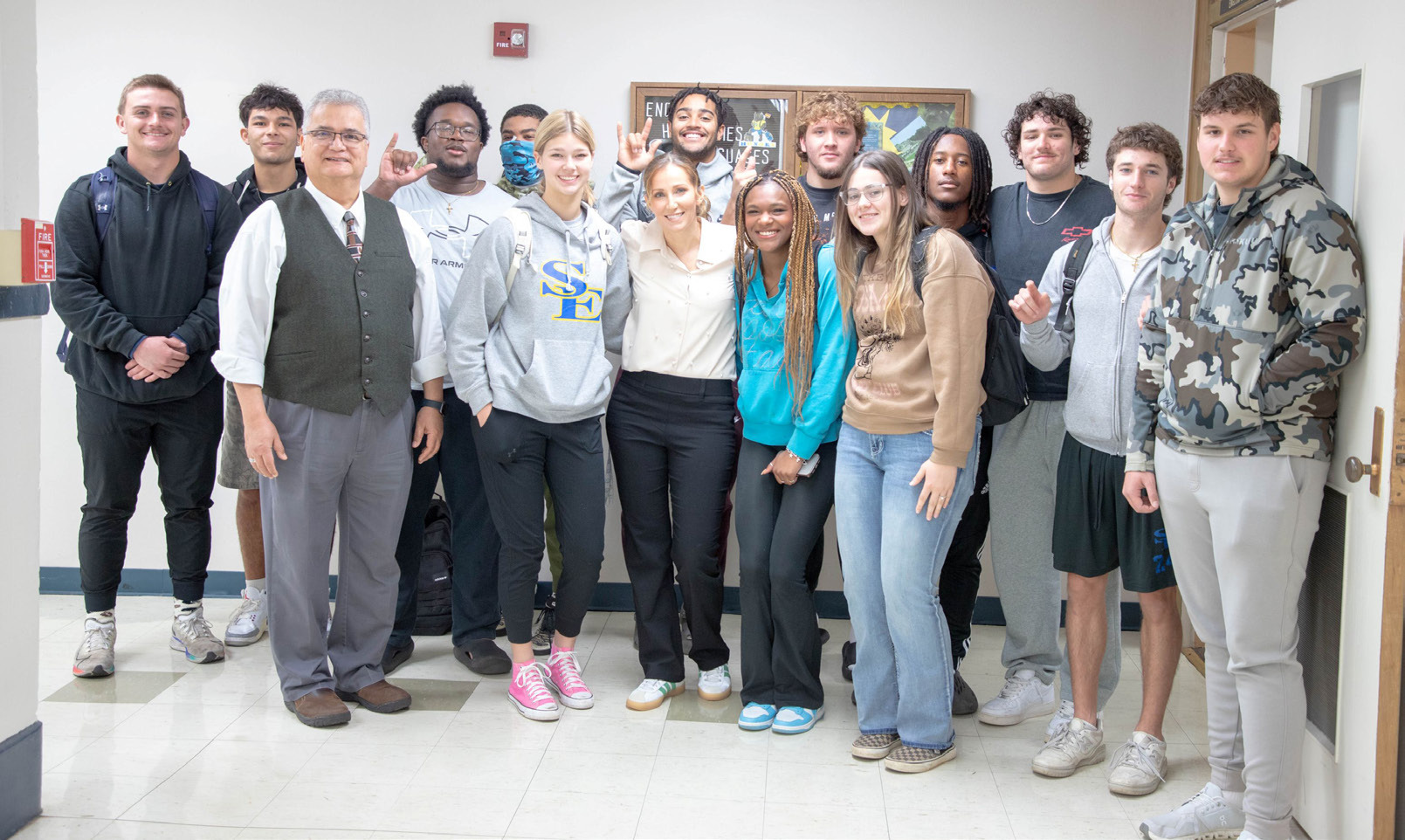
Southeastern instructor Tiara Blue is hearing impaired and has taught online courses for three years at Murray State College after working as a teacher’s assistant at OU for two years.
She was hired in fall 2025 as an adjunct instructor at Southeastern in the Department of English, Humanities, and Languages, and this has given her a unique challenge because she had never taught inside an actual brickand- mortar classroom. Blue teaches freshman English composition classes.
“I taught online and didn’t even think it was possible for me to teach in an actual classroom because of my hearing,” Blue said. “But classroom preferences have changed over the years. There’s been this reversal where younger students are requesting in-classroom over online. So, I decided to give it a try. At first, it was as awkward as I thought it’d be. I couldn’t hear my students. They’d repeat themselves three, four times, and I couldn’t catch the words.” Blue said she does not actually hear in words. She hears snippets.
“I might catch a phrase,” Blue said. “Usually, just the beginning or the center or the end of a word, but never the entire word all together. So, every sentence is very much like assembling a jigsaw puzzle. And if I don’t have enough pieces to create a picture — as a deaf person, I’m just stuck communication wise.”
She credited her students with bridging that communication divide.
“From day one, they were interested in learning sign words. In fact, my first day, some students were looking on their phones trying to figure out how to say ‘Good morning.’ It was so incredibly kind and welcoming, and it made teaching a hearing class a lot less intimidating.”
Blue tried handing out flashcards for students to write questions and thoughts, but that proved to be too cumbersome while interrupting the flow of the class and frustrating the students.
“So, a student came up with pulling out her phone and typing her questions in the story mode of Snapchat, and then she just flipped her phone for me to see,” Blue said. “It’s such a delightful, 21st century solution because it combines the kindness that defines this generation with a medium that they’re clearly comfortable with.”
Now, if Blue cannot understand what her students say, she asks them to type it on their phones.
GROWING UP HARD OF HEARING
Blue has been Hard of Hearing since early childhood. She was a military brat, and her family lived in Giessen, Germany, from mid-1985 to early 1988. While they were there, the Chernobyl disaster occurred.
“Even though it happened in Ukraine, the fallout cloud extended into parts of Europe,” Blue said. “At the time, the military had a TV channel, and they were warning military families to not play in the sandboxes, or eat leafy greens, or drink local cows’ milk, but I did all of the above.”
Blue said her mother did not know any better because she was not aware of the warnings until Blue’s father came home from training.
“That’s around the time my speech completely regressed,” Blue said. “I was two years old. My parents took me to some doctors, and I was misdiagnosed with an intellectual disability. My mom remembers the doctor actually used the term ‘mentally retarded’ to describe me, which baffles my 21st century brain. Unfortunately, this wasn’t an unusual experience for Deaf and Hard of Hearing children back in the 1980s.”
Blue said the misdiagnosis led to some setbacks in her education once the family returned to the United States, and she was placed in special education from kindergarten through first grade. She could not recite the alphabet.
“In fact, my kindergarten teacher openly mocked me because I’d mistakenly guessed the first letter of my name as ‘A.’” Ultimately, that special education classroom became her safe haven.
“I was allowed to fail over and over without being afraid of making someone angry. Over time, Mrs. Caperton, the special education teacher, figured out the little girl who couldn’t spell her name had a deep love of words, and she gave me the tools to nurture that. If anything, as a teacher, I hope to embody her kindness, her compassion, and her keen eye for spotting willing learners.”
COMMUNICATING IN THE CLASSROOM
Blue said micro expressions and facial cues account for about 55 percent of conversation.
“We see that in this classroom,” Blue said. “Because my students know me well enough, they can read my face and know if I’ve heard their question or if I’m struggling, and if I’m struggling, they don’t hesitate. They don’t judge. There’s no awkwardness. It’s almost instinctual. They just start typing and show me the message.”
But what happens when her back is turned? Blue and students figured out an accommodation for that as well.
“We also have a few things we do to catch my attention if my back is turned that are borrowed from the Deaf community, such as they’ll flash the lights if I’m distracted writing on the blackboard. It’s a polite way to let me know, ‘Oh, a student has a question.’” She said she has faced judgment throughout her life for not hearing correctly, however, she is not facing any of that with her students.
“I’ll be honest with you: I’m 40 years old and this is the first time I’m experiencing this in my life,” Blue said. “Before this, I’ve had a gazillion experiences where people have gotten short with me, annoyed, frustrated, angry — all because I couldn’t hear the first go around.”
She describes the anxiety that comes with being Hard of Hearing. Phone calls, running errands, or just interacting with strangers can quickly become stressful events if hearing people become rude or annoyed at having to repeat themselves. In contrast, she said her students have exhibited more patience than people twice their age.
“My students have taught me that there is a clear trajectory here. Young people in this generation - they care about other humans, and they want to help and I think that’s really lovely.”
Blue credits her students for being able to bridge that hearing/deaf divide.
“Invariably, these young students are not only smart - they are kind, and they have the highest emotional IQ I’ve ever seen. So, once they graduate SE, I have no doubts. They are going to be the movers and shakers that make this world a better place.”
Because she teaches Zsection courses, her students tend to be in extracurriculars, such as band and theatre, and athletes from sports, such as football, basketball, baseball, track, and rodeo. The Durant Democrat spoke to some of these athletes last semester about their experiences learning in Blue’s classroom.
“It’s a pretty simple class,” said Josh Tiehi. “If you need help, ask the teacher. We all get along pretty well. Some of us in the class are football teammates, so we already have chemistry and like history because we’re together all the time. So, if we need help, we either ask each other and if we don’t know, then we ask our professor and she can help us easily.”
Slate Starrett said the class is great.
“We do communicate, like messages,” Starrett said. “She’ll either type it or she teaches simple sign language words. She’s very easy to communicate with.”
Dr. Rolando J. Díaz, chair of the Department of English, Humanities, and Languages, said the university is fortunate to have hired Blue at the start of the fall 2025 semester.
“Her commitment to our department and to Southeastern Oklahoma State University is evident in the way she has developed effective teaching strategies in her classes,” Díaz said. “She is an outstanding instructor who is dedicated to the academic success of her students. She is sincere in her relationship with them and detail-oriented in helping them develop important skills related to composition and written expression.”
Blue said she has spent most of her life with about a 50 percent hearing loss, and now, it’s at 75-80 percent loss.
“I’m a Mom of two beautiful, amazing boys, and I want to hear the sound of their voices for as long as I can,” Blue said. “In the meantime, my husband, who is incredible, makes an active effort to learn ASL through Instagram Reels, and we Google certain words and then practice them at home. It definitely helps to have that added layer of communication.”
Becoming a college instructor has fulfilled a wish she has had since she was a college student.
“While I attended college, I often thought, ‘If I could make going to college a career, I’d be set,’” Blue said. “I’m just this little nerd who loves school. I love being in a classroom. I love researching, writing essays, just learning in general.”
In addition to teaching, Blue is also a writer, and she once wrote human-interest stories for the Durant Democrat.
“Both are extremely rewarding,” Blue said. “In fact, I’m nearly finished drafting a middle-grade book about a boy and his robot that I can’t wait to query.”
Blue was recently hired by Choctaw Nation to be a grant coordinator, and she will be teaching until March 2.
“I’ve absolutely adored working for SE, and I’d honestly think it’s the perfect job,” Blue said. “I feel like God presented this opportunity, and I’m excited to see how I can expand that ability of helping my students to helping the community.”
Southeastern adjunct English instructor Tiara Blue, middle, is shown with one of her classes last semester. Also shown on the front row, left, is Dr. Rolando J. Díaz, chair of the Department of English, Humanities, and Languages.