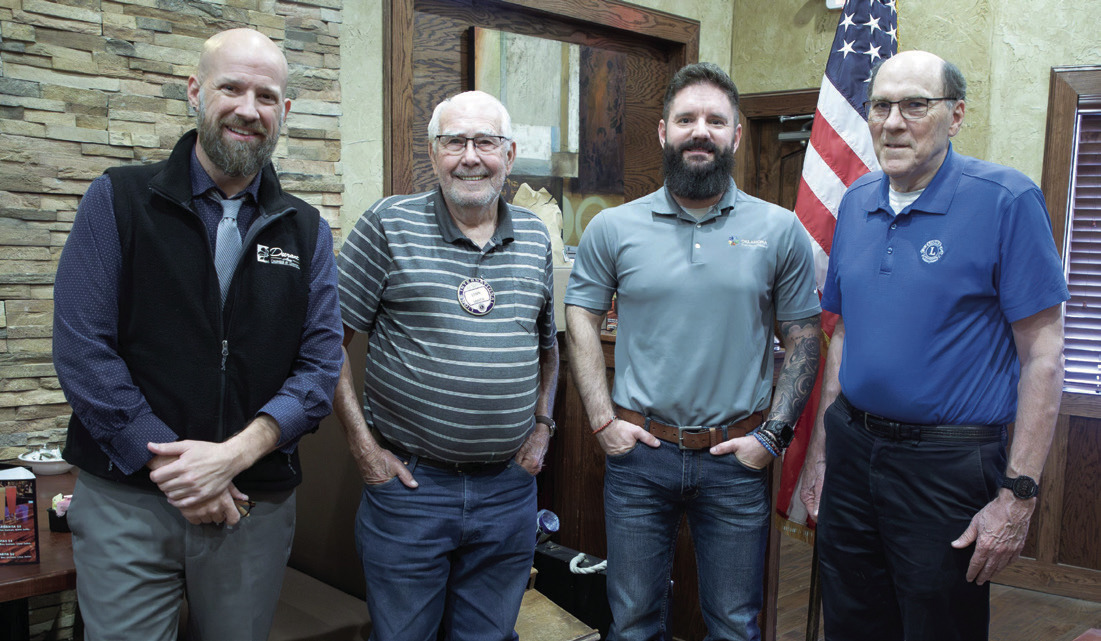
Andreas Weber, Advanced Mobility Coordinator for the Oklahoma Department of Transportation, spoke to the Durant Lions Club last week about the Oklahoma Electric Vehicle Infrastructure Deployment Plan.
Electric vehicle infrastructure is equipment, utilities and connections that allow people to charge their vehicle. This is a five-year plan and Oklahoma’s plan will be updated annually. Oklahoma will receive $66 million over the next five years and the funding will be used to build charging stations along interstate routes during the first year, followed by other designated alternative fuel coordinators, according to information presented by Weber.
Weber said he he doesn’t advocate for or own an electric vehicle (EV), but that “they’re pretty cool little cars” that are fun to drive.
He spoke of the three levels of EV charging.
“Level one is just your standard wall outlet,” Weber said. “You can actually charge an EV off of your wall out of your home and the wall. It’s not recommended to do it that way. To get a full charge, it will take about 48 hours to charge on one of these outlets.
“The most advantageous and cost-friendly way to do it is the level-two chargers. Those are what people are installing in their homes when they purchase EVs and they’re equivalent to a dryer outlet. You need to charge a vehicle overnight, within eight hours, you get a full charge during offpeak hours.”
Weber said that from everyone he has talked to, it increases a utility bill by $0-$60 per month.
“So, for my gas and gasfi lling my vehicle, it’s about a quarter of the cost,” Weber said. “So, if you are looking for an EV, I recommend level-two charging. That’s where you’re going to get your biggest bang for your buck.”
Level-three charging is called direct current fast charging and Weber said it will charge an EV from 25-45 minutes.
He said there are approximately 22,000 registered electric vehicles in the state.
“That might seem like a pretty big number, but when you look in the state, there’s actually four million total vehicles registered in the state so I think that’s .02 percent of all vehicles are EVs. So, Oklahoma has not adopted it as much as the coastal states. EV sales in Oklahoma are up year over year, so it is being adopted.”
Durant currently has two charging stations with four ports.
Weber spoke of the potential economic impact of charging stations.
“The charging sites themselves aren’t going to be money makers, but if you place them along your Main Street, for example, and you have level twos and somebody has to charge four hours, they’re not going to sit in their car for four hours, they’re going to hit your mom and pop shops and spend a little bit of money in the community,” Weber said.
“That’s not only the case in the communities. In all of the talks with Love’s, a multi-million dollar company, we asked them what their business plan is because you’re not going to make any money off these. There’s just not the traffic out there right now. They said, ‘We’re not worried about making the money off the infrastructure. If somebody’s going to be in our parking lot 30 minutes, they’re coming inside and buying something at some point.”’