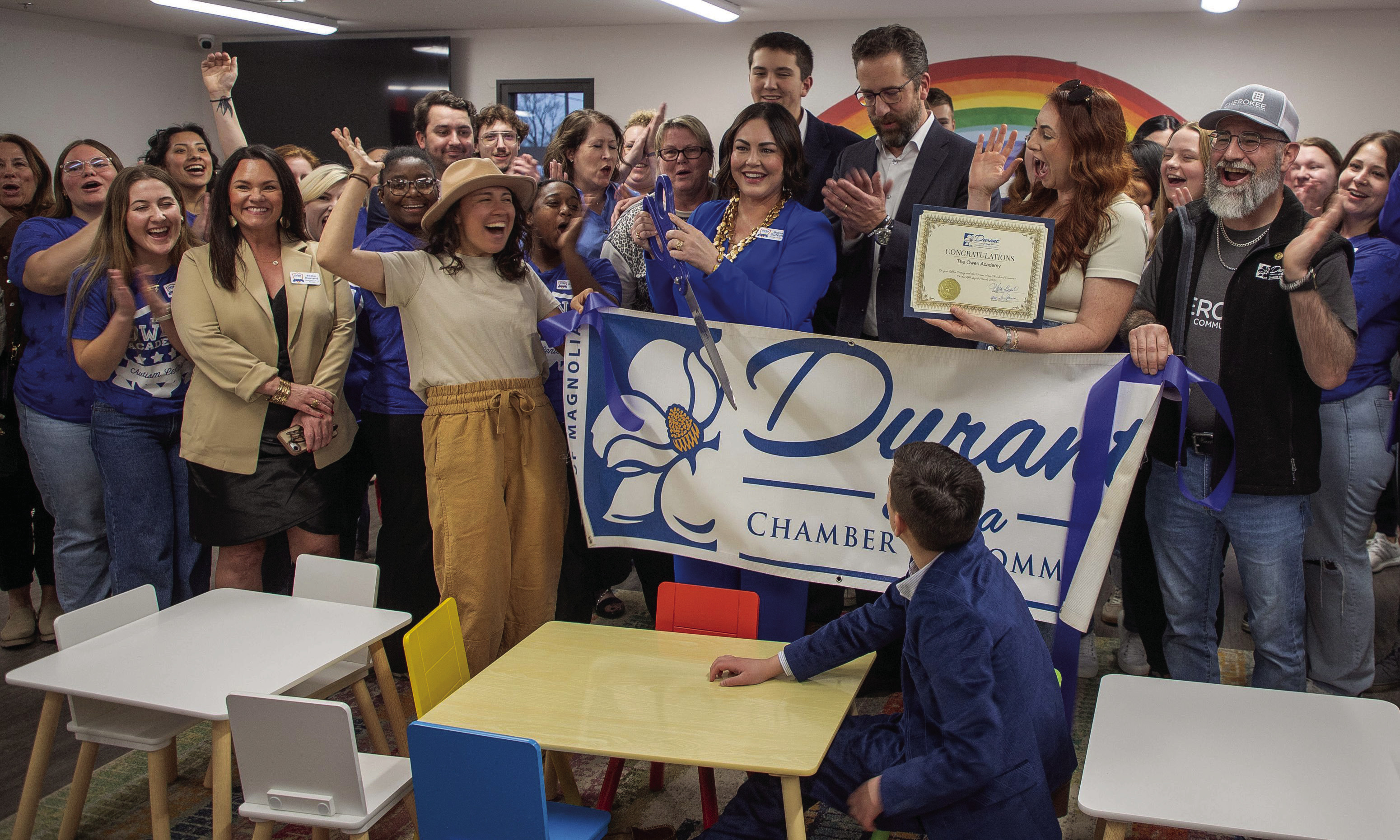
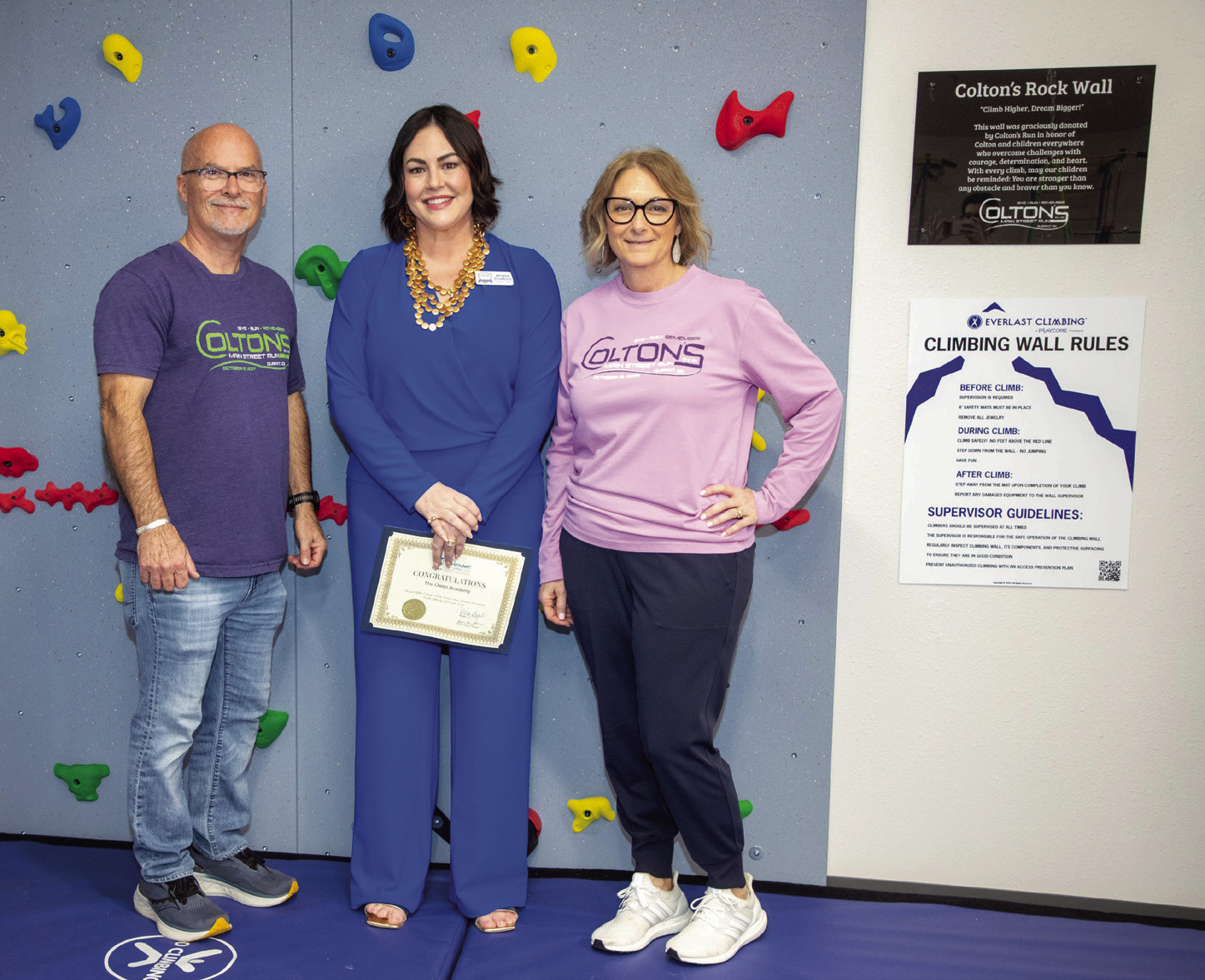
The Owen Academy at 1600 N. Washington Avenue had an open house and ribbon cutting from the Durant Area Chamber of Commerce last week. It is Durant’s first pediatric applied behavior analysis (ABA) therapy clinic that offers child-guided, play inspired, ABA therapy to children ages 2-12 with an autism diagnosis.
Brina Dutton, owner and CEO, said March 4 was the second anniversary of The Owen Academy.
“We opened in Durant because it was an underserved area,” Dutton said. “When my son Owen was diagnosed an H3 (autism level) which was seven years ago, there weren’t any ABA facilities.”
Dutton said they knew immediately that they were outgrowing their space on North Third Avenue, so they looked at different locations.
“Honestly, I prayed about it until we found one that just really felt right, like the right one,” Dutton said. “We saw this space and we just knew that the layout was right and we were able to not only have a large therapy floor area but also individualized rooms for those children that needed more of a quiet space for their therapy.”
According to Dutton, the academy currently has about 20 clients, and the new space will allow them to accept 30-40 more clients.
“We do have a big wait list, and we’re hoping to get a lot of kids off of our wait list with the expansion,” Dutton said.
She said there are many guidelines to follow for insurance purposes, so it is not easy to get new clients started.
“There’s a process in place and so it is a little bit of a lengthy process to get kiddos enrolled, but we’ve already started working on employing more registered behavior technicians, so that we can get some of those kids off the wait list,” Dutton said.
Currently, Owen Academy has about 35 employees, according to Dutton, and they started with five.
Dutton expressed appreciation for community support.
“It means so much to me personally, but I just feel like, I really feel like God just needed someone to do that,” Dutton said. “I feel like the reaction to the community and how many people showed up tonight … it represents the need. So, it represents that need that’s in our community. There’s a need for these services and there’s a need for connection and there’s a need for inclusion and so I think that’s why the community is just really embracing what we do.”
Dutton agreed there is more awareness of autism than there once was, and she credited parents of autistic children for that.
“I can speak to our local area and why there’s more awareness and I think that it’s because of moms, honestly, moms and dads like myself and my husband and a lot of the families that we’ve met in the community who are starting to speak up and stand up for their children and not be afraid to post things on social media,” Dutton said.
“Their quirkiness or their differences and I love that because we should be empowered like that and we should also empower our children to not be ashamed of a diagnosis, right? Like my son is different and he makes funny quirky noises and if he does it and we’re in public, I might make them with him. I just want him to feel included, and I want other families to feel like they can really just be proud of their children for exactly who they are.”
Dutton said she is proud that the academy opened in Durant and she looks to expand to other areas.
“We opened here because it was an underserved area and I was once a mom in an underserved area who had to drive my child an hour each way to get him to therapy for three years and he was in therapy for eight hours a day,” Dutton said. “So, I recognized that Durant didn’t have those services and that’s why we opened here. We do absolutely expect to expand and when we do so, it will be in other rural areas.”
Lance Shelton is the clinical director who oversees all the therapy. He said ABA therapy is based off science.
“Whatweworktowardsisthey can go to school and live the best life that they can,” Shelton said. “We work on their social skills, their communication, their ability to tolerate hard things in life across a lot of environments as well as home, in school and the center and so we do all the work in the center, but it applies to all parts of their life.”
Clients began the therapy as young as two and a half up to 12 with the goal of preparing them for school.
“They are as close to school ready as they can be and a big part of that is parent training,” Shelton said. “I meet with parents every single week and we talk about any problems at home, how to address those things and really take their hand and walk them through this journey because it’s not just, ‘I start therapy and then I’m good to go.’ It’s a long journey and so we work close to the parents because without parents, we can’t do our job the best we can.”
According to Shelton, the therapy can last for years.
“Some clients are two or three years,” Shelton said. “Some are eight or nine years and as long as we are seeing progress and we have goals to work towards, then we will still have them here. If we are no longer effective, then we wouldn’t and we would change things we are doing. My goal as director is to always, if a kid starts at three years old, I want them to be ready to go to school by age six. If we can do it in three years, then that’s the gold standard.”
Some clients are already in school and also attend Owen Academy, Shelton said.
“They would go to school and then come here and so we would work with the school on things that work here to also do those things at school, so they can be the best they can be,” Shelton said.
Shelton said if parents have children on the spectrum, then early intervention is the best way to handle it.
“Start early and get your kid as much help as possible, and you will see a huge difference,” Shelton said.