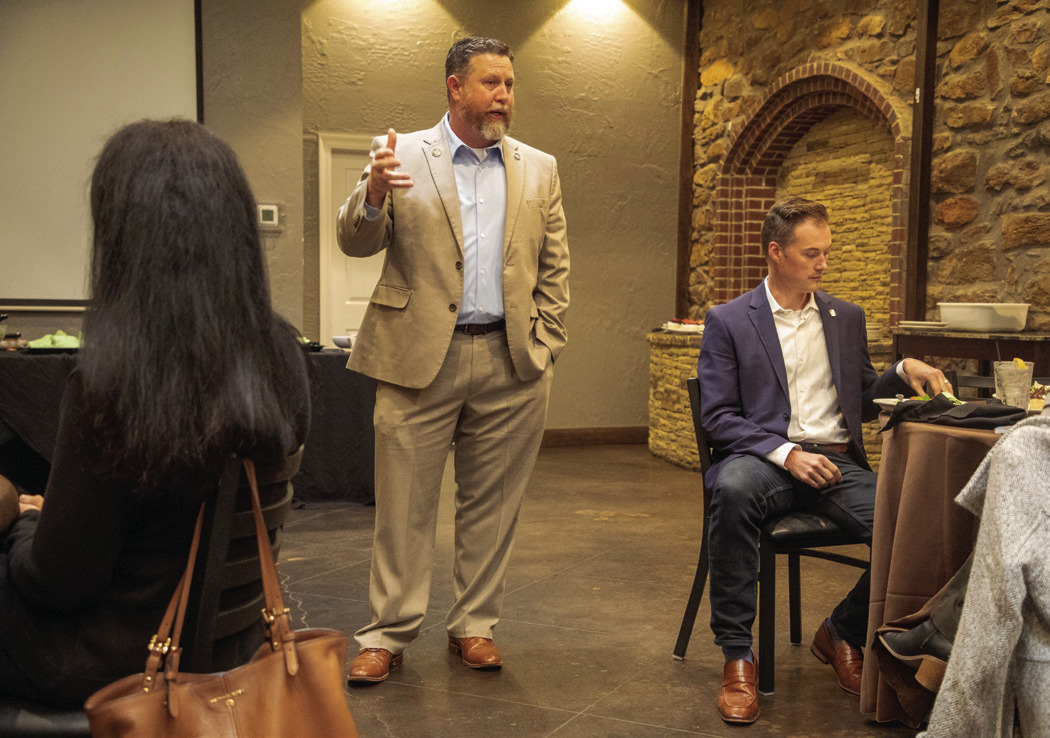
The State Chamber of Oklahoma had an Employers in Action luncheon at Roadhouse in Durant recently that gave human resources (HR) personnel the opportunity to connect with other employment professionals in the area, plus elected offi cials.
Chamber initiatives such as workforce and taxes were discussed and the state chamber also talked about ChamberCare, a new health care option that can save Oklahoma small businesses significant amounts when insuring their employees.
Rising healthcare costs are often a big hurdle for small businesses when it comes to keeping employees and growing their companies. The State Chamber of Oklahoma has a new initiative that could help. In an effort to make Oklahoma the best state in the country to start, run, and grow a business, The Chamber has set up ChamberCare.
It’s a distinctive, self-funded healthcare option administered by Allied, utilizing the extensive Aetna Signature Administrators network. It is exclusively available to small employers who have a minimum of two individuals enrolled in their medical plan, with no more than 50 total employees.
State Sen. David Bullard and State Rep. Cody Maynard were among those attending the luncheon.
“Workforce is the question everybody wants to know about,” Bullard said. “It doesn’t matter if I’m out of education. My wife is assistant principal here at the high school and guess what she’s most concerned about? Workforce, but it’s not in just education, it’s everywhere. A lot of my contention is we have the workforce sitting in a classroom behind a desk and just have to get them trained in the things that we need in our area.”
Bullard said he presents many bills to get more training for workers and for colleges and career techs to know what the training needs are in the area.
“Industry and labor, what are the needs and the gaps and not only the needs and the gaps but what are the coming needs and gaps because if we’re training for today, we’ve already lost,” Bullard said. “We have to start training for the needs 10 and 20 years out.
When Bullard was a teacher, he said he told his students that the jobs they will be taking 20 years from now don’t exist right now.
“So, we’re training you for a job that we don’t even know what it is,” Bullard said. “We just know you got to be able to think this way. Not just memorize things anymore, but the ability to process and that’s why so many of these programs out there are so important when we look at the science of things, how they work and the STEM labs that you see going up, and that’s what I love about rural Oklahoma. If you drive up to Silo, Oklahoma, right now, they have an entire building dedicated to just what? STEM. There’s a reason why they have those things going there, and so it’s been an emphasis of mine for a very long time. I’ve run a lot of legislation on trying to get more money into our brick and mortar buildings.
“They’re already thinking about this, we’ve just got to get them the dollars on target to get those kids the training that they need and go from there. You’re seeing a lot of the needs that are out there. They’re coming into fruition and I think that we can get it done and so I’m excited about those possibilities. When we focus on the things that are right, the economy’s going to come along.”
According to Bullard, businesses will start coming to Oklahoma if the state can supply the workforce and get workers trained in what businesses need.
“Right now, the businesses that are choosing to go somewhere else, they’re No. 1 issue that they’re looking at is workforce,” Bullard said. “That’s the No. 1 thing. Every one of them that we’ve tried to get to come here … all of those different companies that we’ve tried to get to Oklahoma said, ‘We love your tax structure, we love your laws, we love your schools, we love everything about Oklahoma. We don’t like the workforce.’ If we can answer to that, we will see Oklahoma be the largest, fastestgrowing economy in the nation in a matter of a decade.”
Maynard said he was there to learn lessons about what business owners are experiencing in the community.
“Far too often, we get up there in the capitol and a bunch of people who don’t work in business tell us what business owners need,” Maynard said.
He said one of the things that he was a part of last legislative session was abolishing the franchise tax.
“I like to focus on trying to make a good environment for businesses to operate in,” Maynard said.
He spoke of State Question 832 that will be on the ballot in June 2025 and if it is approved by voters, minimum wage would be set at $15 per hour.
“We’ve already got from the federal level new minimum salary amounts going into affect in January,” Maynard said. “We have to through every list and go, ‘Okay, who’s on salary that won’t qualify and what do we do? Do we put them hourly? How do we manage overtime?
“They really changed the landscape of your business and my goal is always to keep the government out of your business as much as possible. I think when the government starts making business worry, then we have a major problem and you know, personally, when we look at the minimum wage going up, most businesses are already paying close to what that’s calling for. I’m just not in favor of the government telling me you have to do that.”
He said that when it comes to the workforce, he has not stopped hearing about a shortage of workers that are needed, so he doesn’t see that problem going away.
“Make better avenues from high school to career techs because a lot of the jobs that we’re also lacking, they are skilled trades,” Maynard said. “If you try to hire a plumber, try to find somebody that can move dirt with a bulldozer. We lack a lot of the skilled trades, and so making good pathways for that is extremely important.”
Janet Reed, executive director of the Durant Area Chamber of Commerce, said infrastructure needs to be strengthened.
“We do not have the capacity to build because we do not have the infrastructure to sustain that building,” Reed said. “How do we go about getting that? Taxes have been cut … How do we get appropriations that go directly to repairing the infrastructure?”
Bullard replied that the tax cuts did not cut any funds coming to the cities for infrastructure.
“That money’s still coming in just like it was,” Bullard said. “The tax cuts were overthe- top money. It didn’t affect any of our spending. As a matter of fact, our budget has grown, not shrunk.”
According to Bullard, the largest need statewide now is not roads and bridges but water and wastewater.
“Oklahoma kind of put its money where its mouth was on roads and bridges for a staple, $590 million,” he said. “The 2019 legislature was the first one to fully fund our roads and bridges fund ever. Back in ‘14, the Obama administration did the study on the bridges and they found we had over 20,000, I think, defective roads and bridges. We’re down to now less than 20.”
He said he is working on funding water and wastewater systems and he recognized the need for improved infrastructure.
“We’ve got a lot of projects like that going to try to help on the infrastructure side of things, but yeah, … We’re aware of a lot of the infrastructure problems that we’re facing in our municipalities and it’s nationwide,” Bullard said.