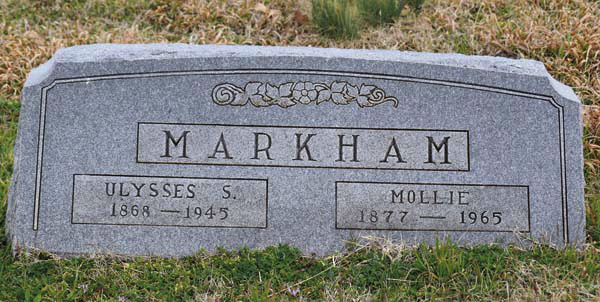
Ulysses S. Markham, son of Judge John Markham, was born in Tennessee in 1868. Later, his family moved to Kaufman County, Texas where he met and married Mollie Kell in 1898. They had two children, Talmage (1899) and Nophlet (1902).
There were already members of the Markham family in Indian Territory, successfully engaged in the timber business and in the manufacturing of “excellent quality brick,” so it wasn’t surprising that U. S. traveled to the territory to investigate the possibility of opening a school. In 1900, he opened one in Caddo, in the Herman Hauer school building, “teaching the young the essential principles of true and noble manhood and womanhood.” He later taught at other locations when time and opportunity allowed.
In 1904, U. S. was appointed postmaster of Caddo and served in that capacity until 1913. He was an outspoken advocate for rural delivery and spent four years encouraging the public to improve the roads around Caddo so that the postal inspector would approve four routes. In August of 1910, he assured local residents that rural mail delivery would enable farmers to obtain their mail daily instead of retrieving it once a week when they went to town. He also urged them to join together to make Caddo a better town. “Let us make the rural routes, the phone systems, the better farming, the better schools, and the better society a reality.” He signed his editorials “Respectfully, U. S. Markham.”
In November of 1911, Ulysses announced that the first route had found favor with the inspector and would soon become a reality. By March of 1912 there were sixty boxes in place and three times that many anticipated.
U. S. was also a dedicated Methodist and a frequent speaker at conventions and other events. In May of 1912, he spoke at the Sunday School convention on the topic of “How to Rule the Unruly.” In 1916, he was the Republican County Convention chairman. That same year, he bought the Morris & Co. insurance agency and had an office over the Pace store.
In 1918, there was an ad in the Atoka paper for Markham Lumber near Farris, but the paper also reported that U.S. sold his interest, rented some property, and took up the lumber business in Caddo. He also continued to teach school, this time in Pleasant Hill, where he later served as principal.
U. S. took the postal exam in 1925 along with Sam W. Maytubby, Mrs. Sophia Pierson, and Mrs. Juanita Bradley. He placed highest on the exam and President Coolidge nominated him because he had also been acting postmaster since October of the previous year. His work had been “highly satisfactory.”
U. S. quickly settled comfortably into his old job and by the end of 1926, the Caddo Herald reported this: “Postmaster Markham reports that during the few days before Christmas the post office handled 97 special delivery and 48 C. O. D. parcels; 306 outgoing insured articles; 330 insured incoming articles, making 703 packages of which a record had to be made. In additions to this there were 1300 packages not insured or registered, making a total of more than 2,000 packages handled in these few days. This together with thousands of uncounted greeting cards and letters indicates that the post office was quite busy, but so thoroughly did the postmaster and his clerk have things in hand that none were lost and there was very little delay. Mr. Markham thanks the public for their consideration and patience and for their well wrapped packages during the time, without which he could not have delivered so good service.” Mrs. Markham was the assistant postmaster.
While U.S. impacted his community and the surrounding areas through his dedicated public service, it was his hobby that ultimately drew the attention of the entire state and made him temporarily famous. Newspapers throughout the state carried this summary of his achievements in 1932: “on his two town lots he produced 67 varieties of fruits and vegetables including pears, peaches, apricots, plums, apples, onions, potatoes, peas, beans, berries and grapes.”
Mr. Crossett, editor of the Caddo Herald, personally visited the Markham garden, expounded on his skills in maintaining it, and carefully listed all the varieties grown. U. S. also had hogs and chickens which benefited from the garden’s bounty. The neighbors were blessed to share his food for their bodies as well as flowers for their souls during a difficult time in our nation’s history. Mr. Crossett commented: “There will be no need for the Red Cross to aid people like this.”
In 1934, following the end of his last term as postmaster, U. S. and Mollie bought the Evans Variety Store in what is now the Cowboy building. Mollie ran the store and U. S. made furniture in a little shop in the back. Many pieces were purchased by local residents and he also completed the furnishing of their home on Bois d’Arc street. They continued in the store until 1943 when declining health prompted them to sell to Mr. and Mrs. Clarence Jones.
Mr. Crossett made the comment in one of his articles about Ulysses that “When the end of the journey comes to U. S. Markham it can be said of him that he was a good citizen; that he did his part toward making the world a better place to live in; and that through him mankind has indeed been blest.” That end came in March of 1945. Funeral services were conducted at the Methodist Church and he was buried in the Caddo Cemetery.