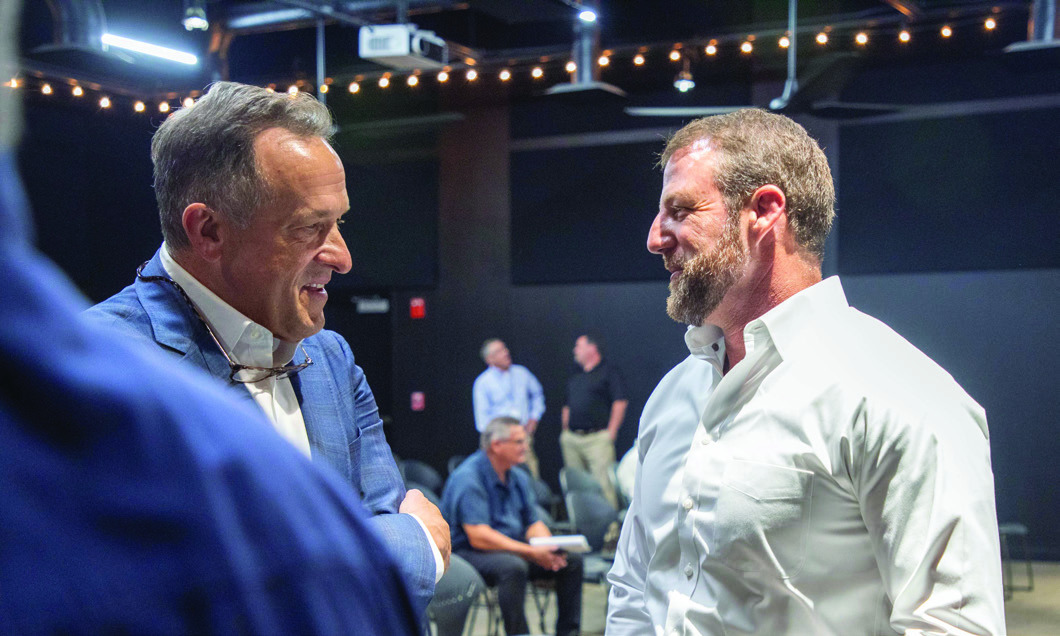
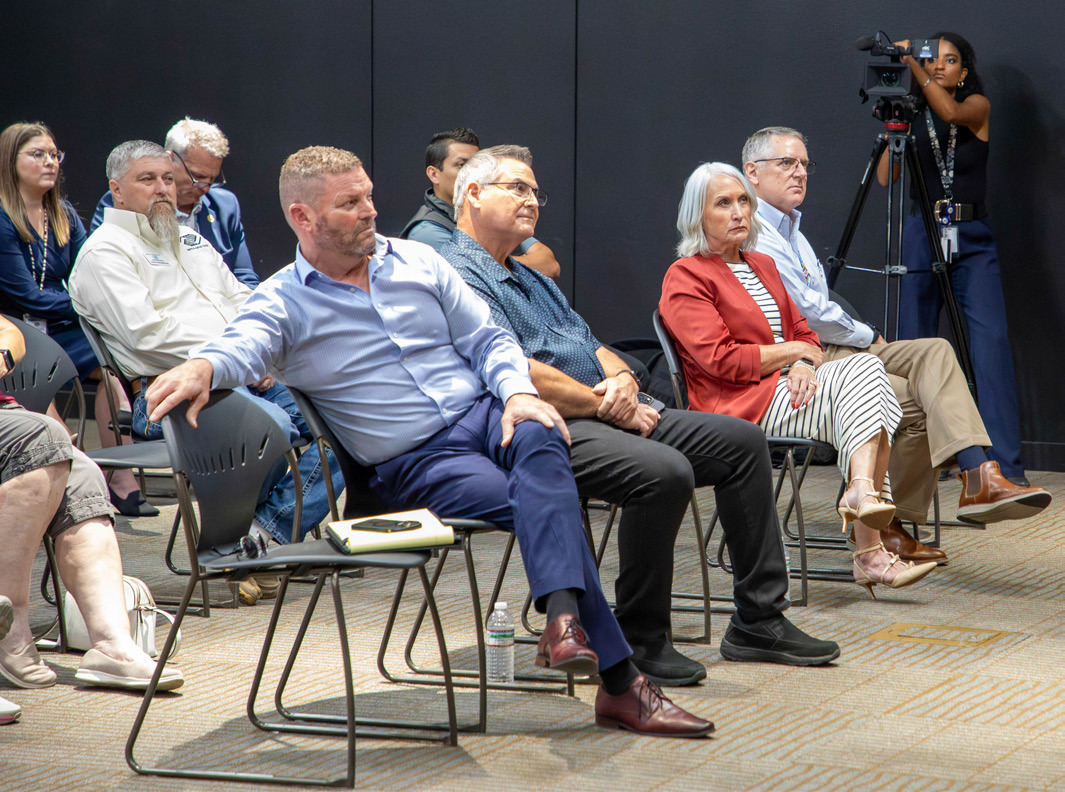
United States Senator Markwayne Mullin and Oklahoma House of Representatives Speaker Charles McCall spoke at the Donald W. Reynolds Community Center & Library last week about several topics, including the roles of state and federal government.
The event was part of a statewide tour highlighting federal partnerships.
Mullin said there is confusion about a state representative and a U.S. representative.
“Most people don’t know … They don’t know the difference between a state senator and a U.S. senator and to be quite frank, I’m not sure I did in 2010 and people don’t know where the state stops and where the federal picks up.
“Most of the issues I get are actually given to me by state reps that call me and all of them have my cell phone number because I tell them if you have constituent ask you something, don’t tell them that this isn’t our problem … just send me their number. All the constituent knows is they want to get it fixed but there’s a tremendous amount of confusion about that.”
McCall spoke on on why he chose public service.
“I found myself in public service and that’s what it is, it’s public service,” McCall said. “I left the private sector to go in for a season for public service and it never was anything that I wanted to do. I really did not like government classes in high school and college but the people in my area asked me if I would run and represent them and they probably did that because they didn’t want to do it but that was why. That’s where I found myself here today. When I entered into the house of representatives off a very, very difficult race, wow, I’ve never done anything harder in my life than run a campaign and that was just for a state house of representative.”
Mullin spoke of his reason for deciding to seek public office.
“The worst financial decision I ever made in my life was to run for office,” he said. “The greatest thing that I have ever done in my life is to go through the humility of running for office because it teaches you so much about it. If someone builds up pride while they’re in office, they’re not doing it for the right reason because it’s the most humbling thing you will ever do, and for me, I ran simply because I got fed up. I’d never went to a political event at all. I wasn’t political, I didn’t watch the news. I didn’t do anything.”
He said that changed when the government changed the clean drinking water standards and that equipment they were developing and shipping all over the country, they were forced to go out of business in four days.
“We have a saying in our family: You’re never going to change anything you’re willing to tolerate,” Mullin said. “A lot of people gripe about stuff and do nothing about it. I had better things to do than to gripe about something I’m actually not going to do anything about. So, my first political event I went to was because of that.
“For the next three and a half years, I was audited by the IRS and the Department of Labor nonstop. They left my office the day Donald Trump was sworn into office. Never fined me, never gave me anything, just left and Joe Biden’s in office, we get audited for another year and a half. Surely coincidental, right?
“It probably didn’t have anything to do with me being in office, but it’s what keeps people out of office … You can’t be afraid of that because they try to run you out. They don’t want normal people running for office. They got this little clique that they want and this ideal that they keep and if you threaten that group, they will come after you either through financial or they’ll come at you on the internet and try to just destroy your character, and if you allow them to win and just backed out, that means you’re willing to tolerate it.”
McCall spoke on the government working with tribes. He said his district is in the Choctaw and Chickasaw Nation boundaries and that they are two fine tribal nations.
“When it comes to State of Oklahoma, we have 39 federally recognized tribes in the state and I see that as a big positive,” McCall said. “The tribal nations do so much for the State of Oklahoma.”
He said the tribal nations make a big difference in the state every day.
“It’s what makes us unique,” McCall said. “Ladies and gentlemen, you have to look no further than our state’s name to see it.”
Mullin said that tribes operate as sovereign nations but that the federal government has an obligation to them because of treaties.
“When we’re able to do a private-public partnership, so we do this all the time with the tribes, the dollar goes farther and what I mean by that is say there is a 500-year flood and it takes out a bunch of bridges and those rural bridges are now deemed to be inside a FEMA disaster area and we’re going to try to get that done,” Mullin said. “But, what happens with us is because it’s washed out, it’s federal. We’ve got to go through all these permitting processes.”
Mullin said that in those cases, there is a federal obligation.
“We can give federal dollars to the tribe or they can already use dollars that they have inside their reservation and they have infrastructure dollars,” he said. “They can go out there and have that bridge built up within two days, and the kids that live on the other side of it the school buses go get which sometimes are tribal kids. Those are just one example. The other is infrastructure when it comes to actually creating jobs, not just from the tribes, but because there’s certain zones that the tribes are within especially with Oklahoma.”
The Roosevelt Bridge replacement project was discussed.
“Roads and bridges are very important to the people of the State of Oklahoma,” McCall said. “They wear out over time. You’ve got to put money back into them. Sometimes you just have to replace them and we see some of that infrastructure.”
McCall said the state has and eight-year road and bridge plan.
“A legislature typically looks one year at a time,” he said. “We’re in a period of time now where the state is looking years, really multiple years ahead but you have to have discipline and you’ve got to stick with it and good things come when you do that. Roads and bridges are something the state does appropriate a lot of money to every year out of its budget but that also gets coupled with federal money.”
McCall said replacing the Roosevelt Bridge is a superexpensive project.
“Out of all of the roads and bridges we have to take care of in the State of Oklahoma, that project up there probably is more than one year’s full budget for this division and so we have to find ways to work together with the federal level to get these projects done,” McCall said. “Thankfully, we’ve had a big champion in Markwayne Mullin, congressman for this district, now a U.S. Senator, and he’s aware of that and we can work together at the state level to raise funds, to match federal funds, to do these big projects.”
Mullin said the bridge replacement project is a good example of the state and federal government working together.
“When we’re trying to do a federal project, the permitting process is sometimes more expensive than the project itself, especially when you’re dealing with water and in this case, the water belongs to federal because it’s Corps of Engineers,” Mullin said. “But, the shore belongs to the state and the tribes so how can we partner that because if we’re going to do it from a federal project as I said, this bridge project was going to double in cost. So, how can we leverage federal with state on this one?
“Well, by doing a match … we’re going to set up a grant program and then we’re also going to set up dollars that’s going to appropriate to it, but we’re not going to run the project. We’re going to allow ODOT to run the project and ODOT at that time can partner with the tribes to run the project. We’ll be able to make the dollar go much farther because we’re stepping away from the federal government and we’re getting the Corps of Engineers to waive everything that’s on top of the pillars. So, the pillars themselves will still be a federal part. That’s going to be a requirement because it’s actually hitting the water. But the decking that goes across it and where we tie on, we’ve basically given it the state.
“So, we’re able to leverage the dollars. I know that’s complicated but that’s where a relationship with the state is so important and then us giving the state the flexibility by appropriating the dollars for it rather than appropriating the project. Huge difference between the two.”