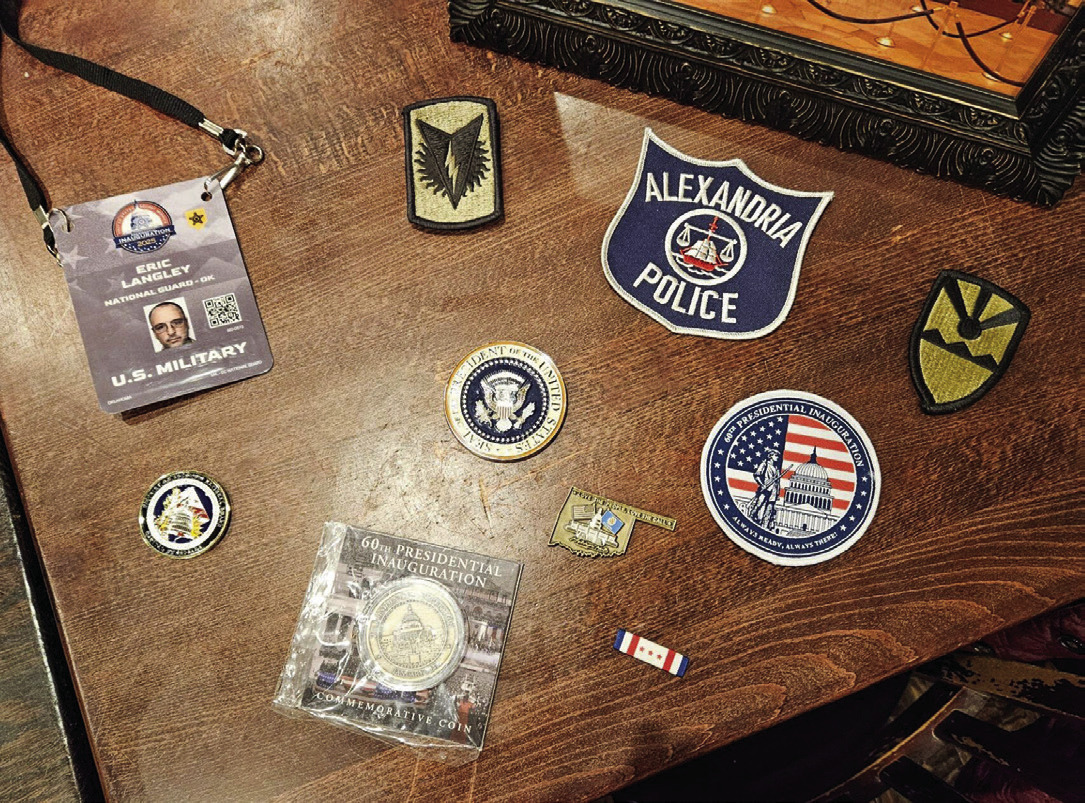
Oklahoma National Guard Capt. Eric Langley was among those who helped with security during the inauguration of President Donald Trump in January and he spoke about the experience during a recent meeting of the Durant Rotary Club.
Now a Durant resident, Langley is from Hugo where he was a band director. He joined the national guard at the age of 30 and after being deployed to Kuwait, he enlisted full time in the guard.
“We’re very proud of him and he had quite an honor this last January,” said his mother Patty Swink, who is also a Rotarian.
Langley said Oklahoma was notified in November that they would be sending 100 soldiers from the 90th Troop Command Brigade to assist other agencies with security.
“It turned out to be the second most meaningful thing I’ve got to be a part of since I joined the military,” Langley said. “The first most meaningful is a couple of years ago, I got to be a part of repatriation mission where we brought a Korean War veteran home that was killed in 1951. His remains were unidentified. They had sat at the Punch Bowl (cemetery) of Hawaii for 70 years and finally through some DNA and some really cool science, they were able to identify who he was and found out that his sister was still alive and lived in Broken Bow. I got to be a part of the mission that brought him back home and it was the most special thing.”
He described the mission to help with security during the presidential inauguration as exciting.
“To be a part of a presidential inauguration and the things that happened there, just kind of blew my mind,” Langley said. “It was kind of a whirlwind adventure and I got to meet a lot of cool people.”
Langley said one of their missions was to provide crowd control for the Capital One Arena, where Trump spoke before and during the inauguration.
“We had two missions where we separated our soldiers,” Langley said. “We had one where we were security for the VIP parking lot and then we had soldiers staged on Pennsylvania Avenue. So, when the motorcade came by, we were providing security and were able to salute the president.
“When we landed, we landed at Joint Base Andrews and this is where things kind of started getting real for me because I’m a Hugo boy, grew up there. At one point, my mission in life was to be a band director for 30 years and retire. That was my goal and I don’t think anything’s wrong that, but I never dreamed that joining the military would put me in places like Joint Base Andrews.”
President Jimmy Carter’s remains had passed through Andrews a couple of days earlier, according to Langley. The soldiers were able to see Air Force 2.
“At the time we landed, that was Kamala’s plane,” Langley said. “When we left, it was J.D. Vance’s plane.”
The soldiers visited with Senators Markwayne Mullin, James Lankford and Oklahoma Governor Kevin Stitt.
“I thought that was pretty cool,” Langley said. “As a military person, I do not politically endorse anyone. We’re a neutral organization. So, what I’m telling you is just a reflection of what our politicians did for us while we were there.”
Gov. Stitt visited them after the inauguration.
“He actually shook hands with every single soldier,” Langley said. “I appreciate them coming and showing that support. It kind of lets our guys know that what they are doing is important and that they are valued and you wouldn’t believe how far that will go to helping our retention numbers. So, we get to keep soldiers just because somebody tells them thank you and that they did a good job.”
Langley said the highlight is when Senator Lankford invited the whole group for a tour of the U.S. Capitol building. Lankford led the tour and took them to the bottom of the Capitol where George Washington was originally going to be buried.
“That’s not part of the tour you could book,” Langley said. “That’s something special he did for our soldiers.”
Langley presented a slide show of photos and one of them showed a reenlistment ceremony on the same stage President Trump was sworn in.
“They got to do their swearin on the stage where there were five presidents not 30 hours before that,” Langley said. “I thought that was pretty special. I got to promote one of the soldiers in the Rotunda. That was one of the most special moments of my career.
“That’s one of the memories I will take away from that. It was quite fun to get on that stage and start realizing historical things that have happened in there because the day before, I was in the command post while the missions were happening. I had the TV on of all of the happenings that were going on, so I was watching them on this stage the day before and then got to be there.”
Langley said that guard members were part of a secondary response force.
“We’re more there as crowd control,” he said. “It’s more support than anything. The intent to use us was never really there. It would take a catastrophic event for us to ever be engaged.”