Editor's note: The school district has now ruled that Jordan Davenport can use his senior portrait of him wearing Choctaw regalia.
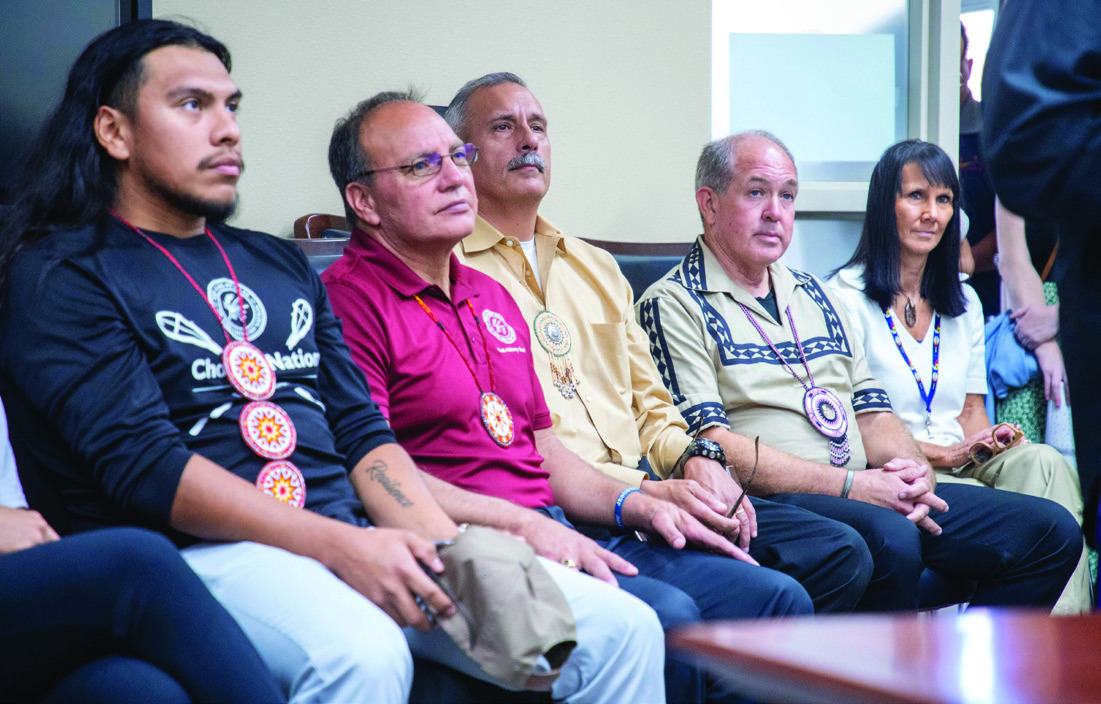
Durant High School student Jordan Davenport addressed the Durant Board of Education on the district’s policy of not being allowed to wear Native American regalia for graduation pictures.
Choctaw Nation Chief Gary Batton, Assistant Chief Jack Austin Jr. and Choctaw District 9 Tribal Council Member James Dry were among those attending the Monday meeting.
Under the school district’s policy, Native American students are allowed to wear tribal regalia during the graduation ceremony, but not for senior pictures.
“Halito (Hello), thank you for giving me the opportunity to speak,” Davenport said.
He cited Oklahoma law that he says allows students to wear tribal regalia, no matter if it is a graduation ceremony or a public or private event.
“The law doesn’t define what is a graduation ceremony,” Davenport said. “Most schools start that process with the senior picture. There are 39 federally recognized tribes in America. You are in the boundaries of the Choctaw Nation and there are plenty of students in the school district that are Native American. For us, regalia is not just decorations. It’s part of our religion, culture and identity.”
Davenport recited the First Amendment to the U.S. Constitution.
“Public schools cannot selectively enforce a dress code to exclude tribal regalia,” Davenport said. “The Supreme Court has protected students’ freedom of expression unless there is a real risk of obstruction. On top of that, title 6 of the Civil Rights Act of 1964 prohibits federally funded schools from discriminating based upon race, ethnicity or national religion.
“Sadly, not every school has honored this right. That is why I’m here today. We cannot forget the history behind this issue. For generations, Native children were taken from their families, placed in government boarding schools designed to erase who they were. They were forbidden to speak their languages, stripped of their traditions, said they had to look like everyone else. Those who survived carry trauma that has been passed down from generation to generation that still impacts Native families today.”
Davenport said his people resisted.
“They kept our languages, our traditions, our ways of life alive,” he said. “That is why I’m wearing my beaded collar, my traditional shirt today. When I’m told I cannot wear it, it feels like history repeats itself. It feels like another attempt to erase us. It feels like my school is ashamed that I’m Native. That I am different from the rest. It feels like an attempt to erase not just my culture, but me from the school’s records. I understand the school wants uniform standards. Those standards are not applied equally. On the school’s website, teachers are shown wearing hoodies, T-shirts, blazers and piercings. If I’m not allowed to wear my regalia, the most important part of who I am, why is that allowed?”
He said his family has spoken to many people and that they believe he should be able to wear his tribal regalia.
“They want it to be seen,” Davenport said. “I want to be clear, I believe the student handbook should allow students to express their culture in an appropriate way. If I’m denied my right, I will take the higher up. I ask from the bottom of my heart that you reconsider. Not just for me, but for every student who comes after me who wants to express their culture in an appropriate way. The more culture is seen, the more it thrives. Do not let this be another chapter of culture erasure. Let it be a chance for our community to come together to respect inclusion and resilience.”
Davenport then said, “Yakoke,” the Choctaw word for thank you and he was greeted with applause.
Board members thanked him for coming to speak and said it took courage, and that his passion for his culture was appreciated.
“I think you presented yourself very well and of course, I assure you that you can wear your full regalia at the graduation,” said Board President Paul Buntz.
Superintendent Mark Moring then spoke about the school district’s policy.
“Students are welcome to wear Native regalia at the graduation ceremony in May,” Moring said. “I love Jordan’s point and this could be the beginning of a great discussion about policy, however, students do not wear regalia for the yearbook picture since yearbook pictures are taken in July and retakes are in September, many of our students have not yet received their cords, stoles and other graduation accessories.”
According to Moring, honor graduates have not been determined at the time of yearbook pictures as well.
“To be fair and consistent to all students, the school chose many years ago for students to wear only the cap and gown for the yearbook picture that is provided by the district and that’s what the policy addresses, but I think it’s a good time to begin a discussion about it and I want to commend you on your talking to the board and that’s hard to do when you’re a teenaged-student,” Moring said. “So, I’m very impressed and that would begin a conversation, but right now, that’s the policy and that was the statement I believe that was shared by (DHS Principal Amber) Mrs. Bullard at the time. Thank you, Jordan.”