We’re all familiar with the ancient magnolia trees that grace the campus of Southeastern and much of the rest of our city. The college also maintains a landscape of grass and shrubs and flowers to serve as a sanctuary for students. However, in its earliest years, much of it was situated on rocky soil covered in weeds and stickers. Morrison Hall rose up in the middle of a peach orchard. Thankfully a young man from Mississippi arrived in 1911 to save the day and begin a beautification program that lasted for over forty years.
There are conflicting stories about where the first magnolia trees came from: 1. Seedlings were brought from Mississippi. 2. Seeds were obtained from a friend. 3. Trees were purchased from a local nursery. However, it’s agreed that the first two trees were planted near the administration building by newly hired biology professor, Ermon Bev Robbins. He had attended college at a campus that was resplendent with magnolias and he missed them.
Many of Robbins’ first endeavors at growing trees from seed failed, but eventually he developed a method that produced consistent results. He also experimented with different varieties, assisted by Ed Kapshinsky. Mozelle Leach, a student who interviewed him late in his career, said he always intended to write down the process of soaking and peeling the seeds, and then publish a book. Sadly, he never did. In 1914, under the leadership of William C. Canterbury, third president of Southeastern, the campus also gained “3,000 privet plants, and a number of Elm, Locust, Maple, Cedar and Umbrella China trees.”
The addition of magnolia trees to the campus prompted more and more plantings throughout Durant as residents learned how to care for them. The Daughters of the Confederacy planted two magnolias on the courthouse lawn in 1919. The Chamber of Commerce had a planting campaign in 1928. In 1951 there was a proposal to widen Fifth Avenue to 45 feet and create a “Magnolia Lane” by planting the trees from Main St. to the college. Magnolias were also the theme of paintings, decorations, signs, and banners.
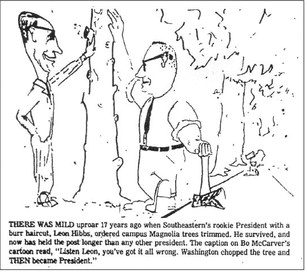
Dr. Shearer was given a magnolia seedling when he retired as president in 1967. He was replaced by Leon Hibbs, who almost immediately found himself in the middle of a brief controversy when he dared to order the beloved trees trimmed. In an article about him, the Durant Daily Democrat remarked “Dr. Hibbs, whose treetrimming efforts have drawn some criticism from old-timers and praise from those who are tired of being hit on the head by low-hanging branches.”
Vernon Snell, outdoor editor for The Oklahoman & Times, commented in 1969 that it was his job during the summers of 192223 to water the trees in front of the administration building. He joked about the length of time it took. “I’m sure there were 1,102 of them!”
In 1969 a curious student named Pam Whittendon counted the magnolia trees and stated in the campus newspaper that there were only 857. Whether anyone argued with her is unclear.
In 1972 Dr. Hibbs agreed to donate 500 magnolia trees from the nursery to beautify the capital. The governor’s wife, Jo Hall, spearheaded the capital beautification project. Oklahoma State donated 300 juniper bushes.
Durant’s first Magnolia Festival was held in 1997. In 1999 Senate Concurrent Resolution 39, sponsored by Senator Billy A. Mickle and Representative James H. Dunegan declared Durant to be the “Magnolia Capital of Oklahoma”. This did not require the governor’s approval, but according to the Durant Daily Democrat, Governor Keating used his executive authority to proclaim “Durant is the Magnolia Capital of Oklahoma for the month of June, coinciding with this year’s Magnolia Festival on June 4, 5, and 6.” Janie Umsted was the chair of that event. The annual celebration continues even now.
To many people the magnolia represents beauty, strength, resilience, and endurance. A fitting symbol for both Southeastern and Durant. And as recently reported in the Democrat, the college has implemented a new program to make sure the trees are properly and lovingly maintained for future generations of students.