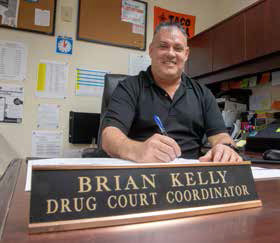
The Bryan County Drug Court was founded in 2005, and it gives those who have been arrested an alternative to prison if they stay clean.
The late Bryan County District Judge Farrell Hatch was instrumental in founding the drug court, and he believed that those struggling with addiction deserved a second chance and that incarcerating everyone for drug offenses was not the answer.
Brian Kelly has been the coordinator for Bryan County Drug Court since 2023, and he was an assistant coordinator for the program for three years prior to that.
“It is an 18-month program where a participant can get their case dismissed if they complete the program,” Kelly said. “There’s five phases. They got to remain drug and alcohol free to go to the different phases, and our success rate is about 80 percent. Two out of 10 don’t make it but we got a pretty good success rate.”
Kelly said that approximately eight people per year graduate from the program and that currently, there are 35 participants.
According to Kelly, there is a criteria to be admitted to the program and drug charges are the No. 1 issue.
“They have different cases like gun charges and stuff like that to get accepted,” Kelly said. “Everything revolves around drugs and stuff one way or another when they get a case. The district attorney is the one who decides who gets in drug court and then their lawyer gets them in drug court.”
The program requires group therapy meetings every week. Participants also have to call in every morning.
They have to attend four group therapy meetings every week, and there is regular drug testing.
“Sometimes, they’re looking at testing two or three times a week to see if they’re remaining drug and alcohol free, and we give incentives and stuff,” Kelly said. “It’s a good program. I went through the drug court myself. I don’t have nothing to be ashamed of. I graduated drug court in 2017, and I’ve been been clean for 10 years. This last Thanksgiving, I was clean 10 years.”
Kelly feels that being a recovered addict himself gives him insight to direct the drug court.
“I know what they’re doing,” Kelly said. “It’s hard for them to get anything by me because I’ve been there and I’ve done that.”
He said he feels their pain and understands what they are going through.
“It’s hard,” Kelly said. “Sometimes, I have to send them to rehab if they can’t get clean, but I like to be here for them and I go to bat for them. But if they get in trouble … they go to prison if they don’t complete the program.”
Kelly said he likes watching the participants grow through the program and staying clean.
“I like to see them even after they graduate,” Kelly said. “I get them a job while they’re in here. I can get their driver’s license back. Just different things that I help them with and they’re at a vulnerable, green stage in their life when they’re coming through here and I just try to guide and direct them and try to let them know that the mistakes that I’ve made in my life and just guide them to graduating out of here.”
Asked what he thinks can be causes of addiction, Kelly said it is social situations and the way someone was raised.
“That wasn’t in my case because I had a good family,” Kelly said. “My mom and dad, my dad never drank, my mom never drank, but I tended to turn toward the latter. I’m where I’m at now and I’m proud of where I’m at. It’s hard. I wish I had done a lot of things different in my life. I love to help them. I’m very passionate about this job.
“I like it and I’m pretty good at it, but they get mad at me sometimes because it’s a lot of tough love. If they mess up, they have to do jail time in the Bryan County Jail sometimes.”
Kelly has pizza parties at the courthouse gazebo for the participants.
“That consists of if there’s nobody in trouble,” Kelly said. “We have court every two weeks, so if there’s nobody in trouble, I throw them a pizza party.”
Kelly said methamphetamine is one of the biggest problem drugs and is difficult to quit.
“Alcohol is a big one,” Kelly said. “The weed is an issue sometimes and pills too, but I would have to say that probably 50 percent of them struggle with meth coming in here. You got your DUI guys, and they all don’t think they have a problem and then when they get in here, they finally realize that they did have a problem and it’s great to see them get clean and get sober.”
A rewarding part of the job for Kelly is seeing participants recover from their addictions.
“I have participants text me all the time saying, ‘Man, I thank you for helping me change my life,’ and I’m like, ‘Well, you did it, not me,’” Kelly said. “I like to see them grow.”
Kelly recognizes that addiction is difficult to conquer.
“Yeah, it is,” Kelly said. “It’s hard.”