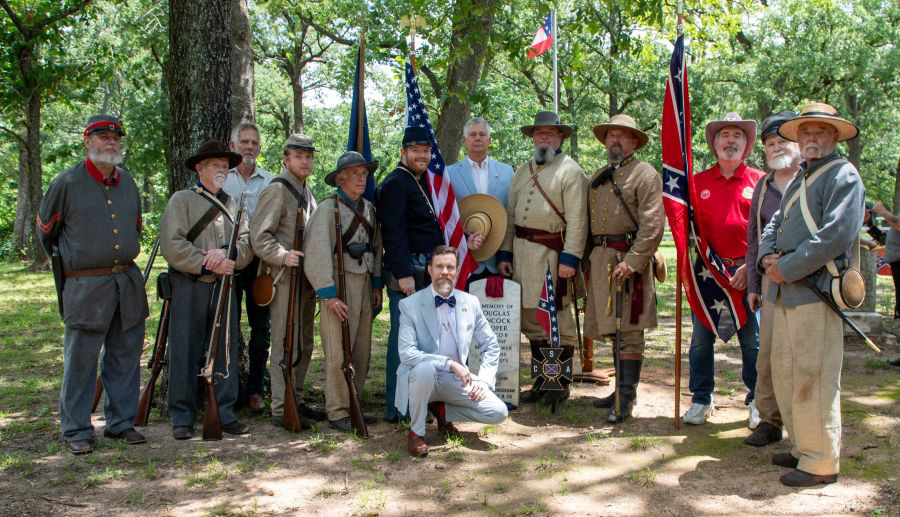
A headstone dedication was held Saturday for Confederate Brigadier General Douglas Hancock Cooper at the Fort Washita Confederate Cemetery. The event was organized by Clem Vann Rogers, Camp 481 Sons of Confederate Veterans Oklahoma City.
Cooper also served in the Mexican-American War and he was a Federal Indian Agent for the Choctaw and Chickasaw tribes.
Eric McBroom, commander of Oklahoma City camp, Sons of Confederate Veterans, said this began as a project of Kevin Easterling, who is a member of the Sons of Confederate Veterans.
“General Cooper has never had a formal gravestone until the research and dedication of compatriot Kevin Easterling culminated in him acquiring one from the Veterans Administration - an unnecessary and unfortunately daunting task to undertake,” McBroom said. “Kevin has been recently honored by the United Daughters of the Confederacy with the Jefferson Davis award for his efforts to get General Cooper’s grave marked with full military honors. If it were not for him, we would not be here doing this today.
Easterling said that upon coming to Oklahoma in 1991 after Desert Storm, Dr. James Castor told him about General Cooper being in an unmarked grave. Easterling wanted to obtain a marker to pay respects to General Cooper, something that was never done.
“I decided about four years ago, I’m going to get the man a marker, one way or another,” Easterling said. “So, I went to the historical society, and I did some research about General Cooper and they had two boxes there with seven envelopes with a bunch of information.
Some of the information was from his own grandson of all people, that said in 1879 that General Cooper died of pneumonia. He had an incident down at Durant and due to the effects of that incident, he died of pneumonia in his cabin right up here.”
According to Easterling, a marker was placed at Cooper’s grave in 1881 and that normally, wooden markers were used in that era. The marker was then stolen and in 1912, Cooper’s grandson said his grandfather was buried within 15 feet of one of the largest trees in the cemetery.
“They raised the money and never got a headstone,” Easterling said. “In 1952, United Daughters of the Confederacy raised the money and got a headstone. Nobody knows where the headstone was. So, during the Biden administration, I decided, okay, I’m going to back door the federal government and the VA. I got the headstone done as a Mexican War veteran, but I happen to know a good friend of mine in Norman that was a stone mason and the additional information that you’ll see on there, I got the honor for General Cooper.”
Easterling said that Cooper, through Jefferson Davis, became an Indian agent for the Choctaw and Chickasaw tribes when they were forcibly removed from Mississippi and Alabama.
“General Cooper helped them fight to get money off the federal government,” Easterling said. “He became their Indian agent and was made a member of the Chickasaw Nation by vote of their own people. So, the war comes along, they fight, everybody’s devastated. Indian Territory has took more casualties and losses than any other Southern state did and this is just in Indian Territory.
“Well, to understand, you look at the history of what happened after the war, the reconstruction, if it wasn’t for this man, Choctaws and Chickasaws would have lost a lot more than they did.”
McBroom said Cooper was born on Nov. 1, 1815 in Mississippi. He attended the University of Virginia from 1832-1834 and served in the Mississippi State Legislature from 1842-1844. He entered the Mexican-American War as captain of a company under Col. Jefferson Davis with the 1st Mississippi Regiment. He fought at Monterey and Buena Vista. It was the Battle of Monterey that he was cited for bravery and gallantry.
Cooper later organized the 1st Choctaw & Chickasaw Mounted Rifles to serve the Confederacy from 1861 to 1865.
“Cooper led troops in the battles of Chustenahalah, Elkhorn Tavern, Newtonia and Honey Springs,” McBroom said. “He was promoted to brigadier general on May 2, 1862, and named district commander of Indian Territory in September of that year.”
According to McBroom, in 1865, Cooper was appointed to Superintendent of the Bureau of Indian Affairs.
“In April 1865, the Choctaw and Chickasaw tribes surrendered and in June, General Cooper ordered the surrender of all Confederate troops in Indian Territory,” McBroom said. “Douglas Cooper swore allegiance to the U.S. Government and was formally pardoned in April 1866. He continued to serve the Choctaw and Chickasaw tribes and was an ardent supporter of their federal land claims.”
In closing remarks, Mc-Broom said that in recent years, there has been a deluge of what America is, what it’s going to be, what to get rid of and what to keep.
“This is the best of what we have, and the world knows it,” McBroom said. “God knows it because he has blessed us with such a great country and so many great freedoms that many travel through toil and all other kinds of dangers and trepidity to come here.”