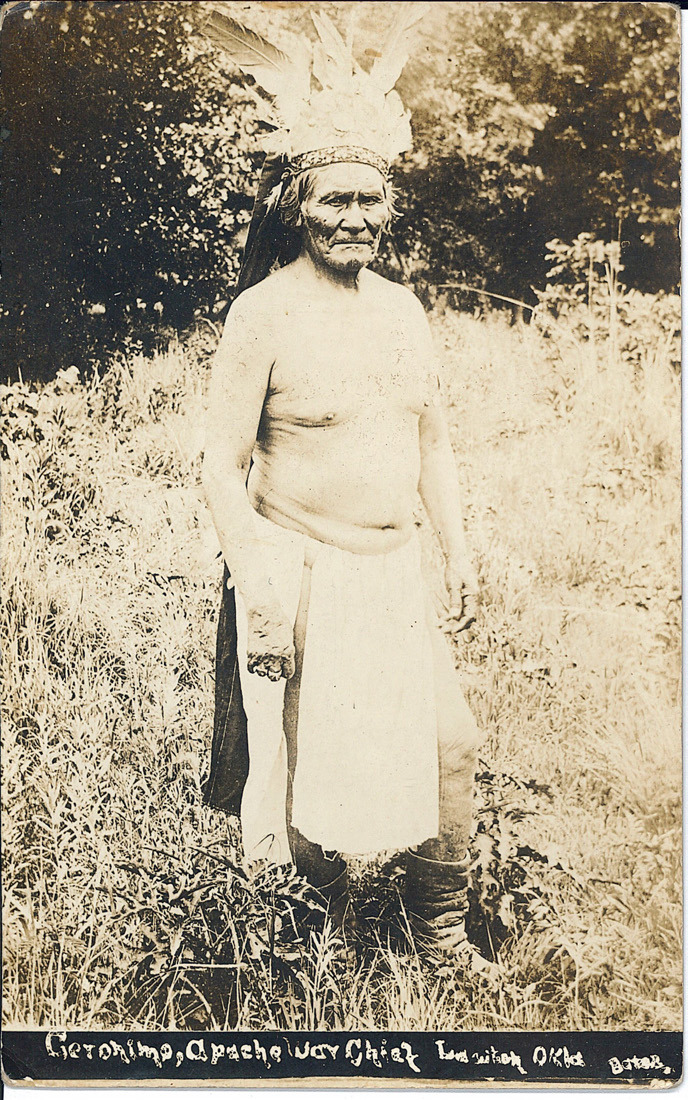
The term “taking a shot” when used by early Oklahoma photographers had nothing to do with a gun or a shot glass of whiskey. Instead, it was meant to capture on film something interesting to the “shooter,” and Oklahoma was loaded with an arsenal of interesting targets to take aim at.
Many American Indians were forced to relocate in what was then Indian Territory, later to be divided into Indian Territory and Oklahoma Territory. By the turn of the century, the territory’s colorful frontier was swiftly being captured in black and white. Dedicated photographers, or as I like to call them, “visual historians,” flocked to early Oklahoma documenting Native Americans, settlers, and events through the lens of their cameras.
Several years ago, I began collecting real photo postcards that caught images of days gone by from both professionals and amateur photographers. During their heyday, real photo postcards not only provided a means of written communication between family and friends, it became possible to actually see one another. Often a photograph showing a town view, a family gathering, or some local event was printed on postcard paper and sent to other family members and friends. It was said by some that before World War I, postcards were the poor man’s telephone.
Although the shutters of vintage cameras clicked pictures of many interesting people and places, I became fascinated with views of the American Indian and especially those from my home state of Oklahoma.
Oklahoma has long been known for its Native American heritage and history. Early on, there was no shortage of subjects or locations to be photographed. From reservations, Indian camps, and Indian fairs, history was being caught on film by small studios and amateur photographers.
With tribes like the Kiowa, Cheyenne, Arapaho, Osage, Ponca, and others living nearby, opportunity abounded for those owning the dedication and desire to record the times on film. Often these early day photographers worked from two very different studios. One being the dirt street storefront of a commercial building, with its theatrical props and hand painted cloth backgrounds hanging from an inside wall. The other “studio” was simply Oklahoma’s wide open spaces utilizing the rugged beauty of its rolling hills and wind swept plains as backdrops. While some old photographs are like seeing an image through cracked glass or muddy water, the images taken by many Oklahoma photographers were as sharp and clear as a cloudless sky.
As fast as the shutter of a vintage camera opens and snaps shut, today becomes yesterday, and the present rapidly becomes the past. Fortunately, many of those fleeting moments were trapped in time for us to see and enjoy today. Much credit for keeping our past alive is due to these individuals. Professional Oklahoma photographers like Dedrick, Drum, Bates, Chaufty, Dillon, and Shiffert quickly come to mind.
John Virgil Dedrick set up shop in Taloga, Oklahoma, near the turn of the century where he began photographing Native Americans, sod houses, settlers, Indian camps, the Indian school at Cantonment, and many other events and scenes from around the area.
Oscar Drum arrived in Bartlesville, Oklahoma, shortly before statehood and quickly opened a studio where he made photographs of townspeople and Native Americans. It is said that prior to Bartlesville, Drum had been a traveling photographer sometimes working from temporary studios inside a tent and a railroad car.
Edward Bates operated a studio on D Street in Lawton, Oklahoma, producing many real photo postcards of local citizens and Native Americans. Comanches who lived near Lawton and Fort Sill, Oklahoma, including the famous Indian Chief Quanah Parker and family members were sometimes found in the eye of his camera. Bates also produced photos of the Apache leader and medicine man Geronimo.
Leon James Chaufty settled down in early Oklahoma in the town of Watonga, named after the Indian Chief Watonga, which I am told means Black Coyote. After purchasing his father’s studio he began photographing the Cheyenne and Arapaho Indians who lived nearby. Chaufty took many pictures at Indian fairs that took place in the area.
Vince Dillon settled for a time with his father near Ponca City where he acquainted himself with the Ponca Indians who lived close by and spent time learning their language. He later moved to Arkansas where he became a registered pharmacist. Missing photography and Native Americans, he pulled up stakes and moved to Fairfax, Oklahoma. It was there he began a photography business with his father. Later, Dillon became the official photographer for the renowned 101 Ranch.
Fred Reuben Shiffert moved to El Reno, Oklahoma, and opened his studio on South Rock Island Avenue where he, like Chaufty, began producing photographs of the Arapaho and Cheyenne people. Shiffert was also known to photograph Sioux Indians that were found in the area.
That said, we should not forget the nameless amateurs who, armed with their camera, a little imagination, and a big desire to freeze moments in time, helped to provide a visual record of Native Americans, settlers, and the American West. Without these dyed in the wool “shutterbugs” much of Oklahoma’s past would have been like the warm prairie wind … it was there, but no one saw it.
Before these words ride off into the Oklahoma sunset, I feel I should mention that some Native Americans did not want to be photographed, believing that the photographer’s “magic box” possessed the power to steal their souls. My wholehearted respect goes out to any who held this belief. Like the sun that travels from the east to the west then disappears, so it was with the days gone by in early Oklahoma. But with the help of many devoted cameramen these departed days will continue to live on in the hearts, minds, and eyes of Oklahomans today, tomorrow, and for generations to come.